
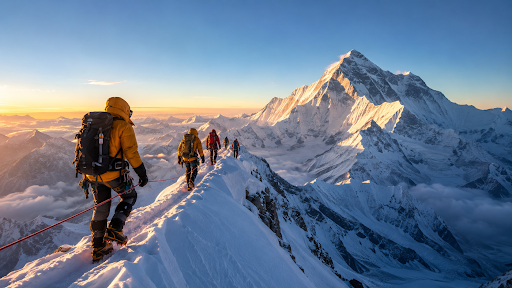
Climbing Mount Everest is not a quick trip to the top of the world. Although the mountain can be seen as a single summit challenge, reaching it requires weeks of careful preparation, gradual acclimatization, repeated climbs between camps, and plenty of waiting.
For most climbers, a full Mount Everest expedition takes around six to nine weeks. Some expeditions finish in about 45 days, while others may last 70 days or longer. The exact schedule depends on the chosen route, weather conditions, the climber’s health, the expedition team, and how quickly the body adjusts to high altitude.
The final journey to the summit may take only a few days, but it comes after weeks of preparation. Understanding the complete Mount Everest climbing timeline helps explain why climbers cannot simply arrive at Base Camp and start heading straight toward the summit.
How Long Does It Take to Climb Mount Everest from Start to Finish?
A typical guided Mount Everest expedition takes approximately 45 to 70 days from arrival to departure. Most commercial climbing teams plan for around two months, giving climbers enough time to reach Base Camp, acclimatize, complete training rotations, wait for suitable weather, attempt the summit, and descend safely.
The full timeline normally includes:
- Traveling to Nepal or Tibet
- Organizing climbing permits and equipment
- Trekking or traveling to Everest Base Camp
- Resting and adjusting to the altitude
- Completing several acclimatization rotations
- Waiting for a safe summit window
- Climbing through the higher camps
- Making the final summit push
- Descending to Base Camp
- Returning to Kathmandu or another departure point
Climbers do not spend every day moving higher. In fact, much of the expedition is spent resting, monitoring health, checking equipment, and waiting for the right conditions.
Mount Everest is nearly 8,849 metres above sea level, and the amount of oxygen available near the summit is extremely low. Moving too quickly can result in severe altitude sickness, exhaustion, or life-threatening medical problems. The long schedule is not unnecessary downtime. It is one of the most important parts of climbing the mountain safely.
A Typical Mount Everest Climbing Timeline
Every expedition company follows a slightly different itinerary, but most Everest climbs include the same key stages. The schedule can change at any time because of weather, route conditions, illness, or delays higher on the mountain.
Arrival and Expedition Preparation
The first few days are usually spent in Kathmandu for climbers approaching Everest from Nepal. Team members meet their guides, attend safety briefings, complete paperwork, and inspect their equipment.
This stage may include:
- Checking personal climbing gear
- Organizing permits and documents
- Meeting guides and Sherpa team members
- Reviewing emergency procedures
- Packing equipment for transportation
- Buying any missing supplies
- Preparing for the flight to Lukla
Although these days may seem separate from the climb, they are an essential part of the expedition. A missing piece of equipment or an incomplete permit can create serious problems once the team leaves the city.
Flights to Lukla are also highly dependent on weather. Poor visibility or strong winds can delay the start of the Everest Base Camp trek by a day or more.
Trekking to Everest Base Camp
For climbers taking the Nepal route, reaching Everest Base Camp usually requires an eight-to-12-day trek. The route passes through mountain villages such as Namche Bazaar, Tengboche, Dingboche, and Lobuche before reaching Base Camp.
The walking pace is deliberately slow. Climbers could cover certain sections faster at lower altitude, but rushing would increase the risk of altitude sickness. Rest days are normally included so the body can adapt as the elevation rises.
The trek also gives climbers time to settle into the expedition routine. They become familiar with the cold, changing weather, basic accommodation, limited facilities, and long days on foot.
The Everest Base Camp trek and the Everest summit climb are very different experiences. Reaching Base Camp is a major achievement for trekkers, but for summit climbers, it marks the beginning of the most demanding part of the expedition.
Resting and Acclimatizing at Base Camp
Once climbers arrive at Everest Base Camp, they usually spend several days resting and preparing before moving higher.
This time allows the body to recover from the approach trek. It also gives climbers an opportunity to practise essential skills and become comfortable with their equipment.
Training at Base Camp may include:
- Crossing ladders while wearing crampons
- Using fixed ropes and ascenders
- Practising rescue techniques
- Checking oxygen masks and regulators
- Reviewing communication procedures
- Learning how to move through crevasses safely
On the Nepal side, climbers must prepare for the Khumbu Icefall, a constantly changing area of deep crevasses, unstable ice towers, and shifting blocks. Moving through this section requires focus, technical skill, and careful timing.
Why Does Climbing Mount Everest Take Nearly Two Months?
The main reason Everest takes so long is acclimatization. The distance between Base Camp and the summit may not seem enormous when viewed on a map, but the extreme altitude changes everything.
Climbers must give their bodies time to respond to the decreasing oxygen levels. This process cannot be safely rushed, even by people with excellent fitness.
Acclimatization Takes Time
At sea level, the body receives plenty of oxygen with each breath. At high altitude, the air pressure is lower, meaning less oxygen reaches the lungs and bloodstream.
As climbers spend time at altitude, their bodies begin making adjustments. Breathing becomes faster, heart rate changes, and red blood cell production increases. These adaptations help climbers function more effectively, but they develop gradually.
Climbers usually follow a “climb high, sleep low” approach. They travel to a higher camp, spend time there, and then return to a lower elevation to sleep and recover. Repeating this process helps the body adjust without remaining at extreme altitude for too long.
Everest Acclimatization Rotations
Most climbers complete two or three acclimatization rotations before attempting the summit.
During an early rotation, a team may climb from Base Camp through the Khumbu Icefall to Camp 1. They may stay overnight before continuing to Camp 2 or returning to Base Camp.
Later rotations may take climbers higher toward Camp 3. Some teams spend a night at Camp 3, while others briefly reach the camp before descending.
A typical rotation may involve:
- Leaving Base Camp during the night
- Crossing the Khumbu Icefall
- Spending time at Camp 1
- Continuing through the Western Cwm
- Sleeping at Camp 2
- Climbing toward Camp 3
- Descending to Base Camp for recovery
Each rotation can take several days. Climbers then need additional rest before starting the next one.
These repeated climbs may look inefficient, but they are a central part of the Everest climbing timeline. Without proper acclimatization, the final summit push would be far more dangerous.
Weather Delays on Mount Everest
Weather is another reason expeditions last several weeks. Strong winds near the summit can make climbing impossible, while heavy snowfall can increase avalanche risk and cover the route.
Climbers may spend days at Base Camp waiting for conditions to improve. Even after completing their acclimatization rotations, they cannot attempt the summit until forecasts show a suitable weather window.
A summit window is a short period when winds are lower and conditions are considered manageable. These windows often appear during May on the Nepal side, but their timing and length vary each season.
If a team moves too early, it may face dangerous winds. If it waits too long, changing weather or the approaching monsoon season may end the expedition.
How Long Does the Final Everest Summit Push Take?
The final Everest summit push normally takes around four to seven days. The schedule depends on the route, the climber’s condition, weather forecasts, and how much rest is needed between camps.
On the South Col route, a summit push may look like this:
- Base Camp to Camp 2
- Camp 2 to Camp 3
- Camp 3 to Camp 4
- Camp 4 to the summit
- Summit back to Camp 4 or Camp 2
- Return to Base Camp
Some climbers stop at Camp 1 during the ascent, while others move directly from Base Camp to Camp 2 if they are well acclimatized.
Camp 4, located on the South Col, is the final camp before the summit. It lies inside the death zone, where the body cannot properly recover because oxygen levels are so low. Climbers spend as little time there as possible before beginning the summit attempt.
How Long Does Everest Summit Day Take?
Everest summit day is often the longest and most exhausting part of the entire expedition.
Climbers usually leave Camp 4 late in the evening or around midnight. Starting at night gives them enough time to reach the summit in the morning and descend before conditions become more dangerous.
The climb from Camp 4 to the summit often takes between eight and 12 hours. The return to Camp 4 may require another four to eight hours, meaning the full summit day can last approximately 12 to 20 hours.
Several factors can affect the pace:
- Strong winds and extreme cold
- Deep or unstable snow
- Physical exhaustion
- Problems with oxygen equipment
- Crowds at narrow sections
- Queues along fixed ropes
- The climber’s experience and health
- Delays caused by rescues or emergencies
Summit day is not a race. Climbers need to maintain a steady pace while paying close attention to their oxygen supply, body temperature, energy levels, and turnaround time.
How Long Do Climbers Stay at the Top of Mount Everest?
Most climbers spend only a few minutes on the summit of Mount Everest.
After weeks of preparation, the time at the top is surprisingly short. The summit is exposed to intense cold and strong winds, and every extra minute at that altitude places additional strain on the body.
Climbers may use their time on the summit to take photographs, contact their expedition team, record proof of the ascent, or look briefly across the surrounding Himalayan peaks.
They must then begin descending. Reaching the summit is only half of the challenge, and climbers still need enough oxygen, strength, and concentration to return to a safer altitude.
How Long Does It Take to Descend Mount Everest?
Descending from Mount Everest is faster than climbing, but it is not easy or risk-free.
After reaching the summit, climbers usually return to Camp 4 on the same day. Some may continue lower if they have enough energy, while others need to rest before descending again.
The journey from the summit back to Base Camp generally takes around two to four days. The exact duration depends on the climber’s health, weather conditions, route congestion, and the amount of support available.
Descending can be especially dangerous because climbers are already exhausted. Their judgement may be affected by fatigue, dehydration, cold, or a lack of oxygen.
Common risks during the descent include:
- Losing balance on steep terrain
- Making errors while using fixed ropes
- Running low on supplemental oxygen
- Developing frostbite or altitude illness
- Becoming trapped by changing weather
- Struggling to pass other climbers on narrow sections
Many Everest accidents happen during the descent rather than on the way up. Experienced climbers understand that the expedition is not successful until the entire team has returned safely.
How Long Does It Take to Climb Everest from the Nepal Side?
Climbing Everest from Nepal usually takes around six to nine weeks. The South Col route is the most popular choice for commercial expeditions and begins with the trek through the Khumbu region.
After reaching South Base Camp, climbers complete rotations through the Khumbu Icefall, Camp 1, Camp 2, and Camp 3. They then return to Base Camp or a lower village to recover before the summit push.
The Khumbu Icefall has a major influence on the schedule. Teams often cross it during the early morning when colder temperatures make the ice more stable.
Even then, the route can change from one day to the next. Ladders may need to be repositioned, crevasses can widen, and unstable sections may temporarily close.
The Nepal route also attracts large numbers of climbers. During a limited summit window, crowds can cause delays at Camp 4 and along the upper route.
How Long Does It Take to Climb Everest from the Tibet Side?
An Everest expedition from the Tibet side generally lasts around six to eight weeks, although schedules vary.
The northern approach is different because climbers can travel much closer to Base Camp by road. This removes the long trek through the Khumbu Valley, but it does not eliminate the need for acclimatization.
Climbers still complete several rotations between Base Camp, Advanced Base Camp, and the higher camps. The northern route is known for exposed terrain, strong winds, and technically demanding sections near the summit.
Access rules and permit conditions can also affect the timeline. Expeditions on the Tibet side depend on government approval, border access, and local operating restrictions.
A shorter journey to Base Camp does not necessarily mean a faster summit climb. The body still needs time to adapt, and weather remains one of the biggest factors.
North Route vs South Route: Which Everest Climb Takes Longer?
There is no clear rule that says one Everest route always takes longer than the other.
The South Route from Nepal includes a longer trek to Base Camp and repeated crossings of the Khumbu Icefall. The North Route from Tibet offers easier road access to Base Camp but includes a lengthy journey to Advanced Base Camp and highly exposed upper sections.
Both routes require:
- Several weeks of acclimatization
- Multiple climbs between camps
- Rest and recovery periods
- Route preparation
- Suitable weather
- A safe summit window
- Time for the descent
The overall duration often depends more on the expedition strategy and mountain conditions than the side chosen.
A team with favourable weather may finish earlier, while another team on the same route may wait for days because of strong winds or heavy snowfall.
What Can Extend or Shorten an Everest Expedition?
A published Everest itinerary is always an estimate. Expedition teams build extra days into their schedules because delays are common and often unavoidable.
Weather and the Summit Window
Weather can add several days or even weeks to an expedition. If summit winds remain too strong, climbers must stay at Base Camp regardless of how prepared they feel.
Teams may also abandon an initial summit attempt and return to lower camps before trying again during another weather window.
Health and Acclimatization
Not every climber adjusts to altitude at the same speed. One person may feel strong at Camp 2, while another experiences headaches, nausea, poor sleep, or breathing difficulties.
Illnesses such as chest infections and stomach problems can also delay progress. Even a minor health issue at sea level can become serious at altitude.
Route Conditions
Avalanches, damaged ropes, unstable ice, deep snow, and crevasses can temporarily close sections of the route.
Teams sometimes need to wait while Sherpa climbers and route-fixing groups repair or establish the path.
Crowds on the Mountain
Everest has a limited number of suitable summit days each season. When several teams choose the same day, long queues may form at narrow or technical sections.
Crowding can slow the ascent, increase oxygen use, and force climbers to spend more time in extreme cold.
Expedition Style
Traditional expeditions usually follow a six-to-nine-week schedule. Some operators now offer shorter programs for experienced climbers who use altitude tents before arriving in Nepal.
Pre-acclimatization may reduce the time spent on the mountain, but it does not remove the need for high-altitude experience or careful decision-making.
Can You Climb Mount Everest Faster Than the Average Expedition?
It is possible to climb Mount Everest faster than the standard expedition timeline, but shorter schedules are not suitable for most people.
Elite mountaineers have completed exceptionally fast ascents, and experienced climbers may arrive after acclimatizing on another high-altitude peak. Some also use hypoxic tents that simulate higher elevations while they train at home.
A faster Everest expedition may involve:
- Pre-acclimatization before arrival
- Recent experience above 7,000 metres
- Strong technical climbing skills
- A small and highly experienced team
- Flexible helicopter or travel logistics
- Limited time at Base Camp
- A favourable weather forecast
However, speed can create additional risk. High-altitude illness does not care how fit a climber is, and a short itinerary leaves less room for bad weather, sickness, or unexpected delays.
For the average climber, completing a full acclimatization program remains the safer and more realistic approach.
How Long Should You Train Before Climbing Mount Everest?
Many climbers train specifically for Everest for at least one to two years. Building the necessary mountaineering experience may take much longer.
Training usually combines endurance work, strength exercises, technical climbing practice, and long mountain days while carrying a heavy pack.
A serious Everest training plan may include:
- Running, cycling, or stair climbing
- Long hikes with increasing pack weight
- Leg, back, and core strength exercises
- Crampon and ice axe practice
- Ropework and crevasse rescue
- Cold-weather camping
- High-altitude expeditions
- Recovery, sleep, and nutrition planning
Climbers also need mental endurance. Everest involves discomfort, uncertainty, cold, poor sleep, long periods of waiting, and difficult decisions.
Training is not only about reaching the physical condition needed to climb upward. It is also about staying focused and making sensible choices while tired and under pressure.
From Beginner to Everest: How Many Years of Experience Do You Need?
There is no fixed number of years required before climbing Everest, but beginners should expect to build experience gradually.
Physical fitness alone is not enough. Climbers need to understand how their bodies react to altitude, how to use technical equipment, and how to make decisions in dangerous mountain conditions.
A sensible progression may include:
- Completing multi-day trekking trips
- Learning basic mountaineering skills
- Climbing snow and ice routes
- Gaining glacier travel experience
- Attempting peaks above 6,000 metres
- Climbing a 7,000-metre mountain
- Gaining experience on another 8,000-metre peak
- Learning to use supplemental oxygen
Some climbers prepare for Everest over five or ten years. Others progress more quickly because they have regular access to mountains and professional training.
The goal should not be to reach Everest as soon as possible. The goal should be to arrive with enough experience to recognise danger, handle problems, and make safe decisions without depending entirely on a guide.
How Much Does a Two-Month Mount Everest Expedition Cost?
The long expedition timeline is one reason climbing Everest is so expensive. Climbers are not simply paying for a guide to take them to the summit. They are paying for weeks of logistics, staffing, food, accommodation, transport, equipment, and emergency support.
Common expenses include:
- Everest climbing permits
- Expedition guides
- Sherpa support
- Base Camp facilities
- Meals during the trek and climb
- Supplemental oxygen
- Fixed ropes and route preparation
- Tents at multiple camps
- Domestic flights and ground transport
- Insurance and evacuation coverage
- Personal mountaineering equipment
- Tips and staff bonuses
Costs vary widely depending on the operator and level of support. A basic expedition may offer fewer services, while premium packages may provide additional oxygen, private guides, more comfortable Base Camp facilities, and greater logistical support.
Unexpected delays can also increase spending. Climbers may need additional hotel nights, changed flights, medical treatment, or extra equipment if the expedition lasts longer than expected.
The Full Time Commitment Beyond the Mountain
The six to nine weeks spent on Everest represent only one part of the total commitment.
Before the expedition, climbers may spend several years gaining experience and one or two years following a focused training program. They also need time for medical checks, equipment testing, travel planning, visas, permits, vaccinations, and insurance.
After the expedition, recovery may take several weeks. Climbers often return home with weight loss, muscle fatigue, disrupted sleep, and the effects of prolonged exposure to altitude.
The complete time commitment may therefore include:
- Several years of mountaineering experience
- One to two years of serious physical training
- Weeks of expedition planning
- Six to nine weeks on the Everest expedition
- Additional travel and recovery time
So, how long does it take to climb Mount Everest from start to finish? The expedition itself normally lasts around two months, but becoming ready for it can take years. The long schedule is not simply about reaching the summit. It gives climbers the time they need to adapt, wait for safe conditions, make the attempt, and return from the mountain alive.